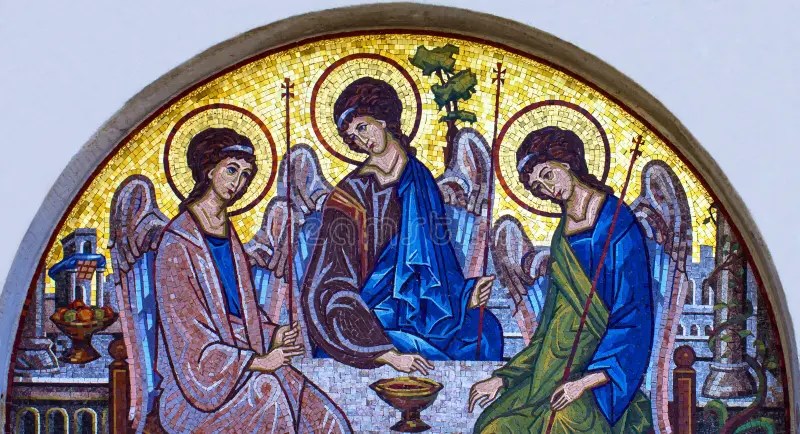
We believe that the Father is the unbegotten source of the Godhead. We believe that the Son is begotten of the Father, deriving his existence from the Father by generation. And we believe that the Spirit is proceeding from the Father, deriving his existence from the Father by procession.
This is expresses the essential Nicene confession.
So, what’s the difference between “generation” and “procession”?
The core distinction is their mode of existence (some theologians use the word “origin”). This speaks to what distinguishes the three persons of the holy trinity. And this is important because what cannot distinguish them is the unique possession of any of the attributes of divinity, otherwise they would be separate gods. So one cannot posses an attribute of divinity that the others do not. Therefore, the question of their existence is one of “relationship”.
So their modes of existence are:
> The Father: unbegotten (agennetos) — he is the sole arche (source, principle) of the Godhead.
> The Son: begotten (gennetos) — he derives his existence from the Father by generation.
>The Spirit: proceeding (ekporeuomenos) — he derives his existence from the Father by procession
These are their relational identities. They don’t describe what the persons are like, but how each person exists in relation to the Father as source. And the exact nature of these relationships remains one of the mysteries of the trinity.
However, within that mystery, we can say that “begetting” (gennesis) connotes something like the generation of a word from the mind, or of an image from light. The Son is likened to a kind of expression or image of the Father. So the Son is the Logos, the express image of the Father (Heb. 1:3), eternally generated as the Father’s self-expression. Meanwhile, “proceeding” (ekporeusis) connotes something like breath or gift. The Spirit proceeds as the Father’s living self-giving. So the Son is the image while the Spirit is the life.
These observations raise an important question about the Christian’s “renewal and regeneration”. We must ask, if the eternally begotten Son and the eternally proceeding Spirit describe their existence in relationship to the Father, and we are meant to be born again in the likeness of the Son and receive the resurrection life of the Spirit, then what does this mean for our relationship with the trinitarian divine nature?
This expresses the beauty of the gospel in some very meaningful ways.
Salvation is not merely a forensic transaction, but is the participation in the life of the Trinity. We are transformed via adoption and sanctification. The modes of existence of the Son and Spirit within the immanent Trinity correspond structurally to the modes of renewal in the believer. The Son is begotten (generation) of the Father so the believer is born again (regenerated) into the Son’s filial relation with the Father. The Spirit proceeds (procession) from the Father so the believer receives (reception) the Spirit as the living breath of new resurrection life.
So regeneration is our participation in the Son’s Sonship.
The language of new birth is consistently filial, being principally about becoming children of God, not merely being pardoned criminals or improved moral agents. The apostle John wrote, “But to all who did receive him, he gave them the right to be children of God, to those who believe in his name, who were born, not of natural descent, or of the will of the flesh, or of the will of a husband, but of God.” (John 1:12–13), and again, “Whatever is born of the flesh is flesh, and whatever is born of the Spirit is spirit.” (John 3:6).
The logic is participatory. We are born into something that already exists. We don’t generate a new kind of sonship, but are brought into the Son’s own relationship with the Father.
Paul makes this explicit, saying “For you did not receive a spirit of slavery to fall back into fear. Instead, you received the Spirit of adoption, by whom we cry out, ‘Abba, Father!’ The Spirit himself testifies together with our spirit that we are God’s children.” (Rom. 8:15–16).
We cry “abba”, the same as Jesus in Gethsemane (Mark 14:36). We are not given a similar relationship to the Father, but are given his relationship by adoption into it! The Son’s eternal begottenness becomes the template and ground of our creaturely regeneration. This is why we are called “co-heirs with Christ” (Rom. 8:17) rather than simply heirs alongside him. Our inheritance is derivative of and dependent on his. We are begotten again because he is the eternally begotten one — the monogenes (John 1:14, 3:16) whose singular filial existence is opened up to include us.
And the Spirit is the life of the new creation.
If regeneration gives us the form of sonship, then the Spirit gives us the life that fills that form. This fits into the procession distinction with real precision. The Spirit is the agent of life-giving breath: creation (Gen. 1:2, 2:7), prophecy (Ezek. 37), resurrection (Rom. 8:11), and new birth (John 3:5–8). He doesn’t generate a new image or identity, but animates what the Son has constituted. The Son is the pattern; the Spirit is the life poured into the pattern.
So Paul says, “And if the Spirit of him who raised Jesus from the dead lives in you, then he who raised Christ from the dead will also bring your mortal bodies to life through his Spirit who lives in you.” (Rom. 8:11)
The Spirit is the resurrection life of the Father flowing through the Son’s resurrection into us. The Father is the source, the Son’s resurrection is the event, and the Spirit is the actual living presence that indwells. This is not merely a functional description, but mirrors the immanent structure: the Spirit proceeds from the Father, but his procession is always in relation to the Son, arriving in creation through the Son’s accomplished work.
Here we need theological precision: the modes remain asymmetric in our renewal just as in the immanent Trinity, and that asymmetry is instructive: we are not “begotten and proceeding” in some undifferentiated way. We receive these two distinct gifts that remain distinct: Regeneration gives us identity as we become children, named, adopted, in a filial relationship that is objective and permanent. This corresponds to the Son’s begottenness, which is about who he is, his personal subsistence as image and Word. Indwelling gives us life as we are animated, moved, sanctified, gifted by a living presence within us. This corresponds to the Spirit’s procession, which is about life and gift, the Father’s self-giving vitality.
I think we lose the sense of one without the other. A Christianity heavy on identity/adoption but thin on Spirit tends toward intellectualism or mere moralism (i.e. right status, little transformation), whereas a Christianity heavy on experiential Spirit-life but thin on filial identity tends toward enthusiasm without stability (i.e. movement without grounding).
The Trinitarian structure actually diagnoses these pathologies.
“The Father’s Role: Source Without Being Received.” Notice what this implies about the Father in our experience: he is not directly “received” in the way the Son and Spirit are. We are not “born of the Father” in the same immediate sense, nor does the Father indwell us as the Spirit does. He is the source toward whom we are oriented. He is the Abba to whom we cry, the one whose face we seek. The Son and Spirit are, in a sense, the two modes by which the Father gives himself to us without ceasing to be the inexhaustible source. So the Son reveals the Father (exegetes him, John 1:18 — the word is exegesato, “he has made him known”). The Spirit draws us into that revelation as living participants. But the Father himself remains the goal, the depth, the one “to whom” everything moves.
Again Paul says in 1 Corinthians 15:28, “And when everything is subject to him, then the Son himself will also be subject to the one who subjected everything to him, so that God may be all in all.”
The whole movement of redemption — through the Son, by the Spirit — is toward the Father. The Trinitarian structure of our renewal isn’t just a description of our past conversion; it’s the shape of the entire Christian life and its eschatological destination.
Now, because there’s always a risk of miscommunication, it’s necessary for me to guard against misunderstanding: the parallel between the immanent Trinity and our renewal is real but analogical, not unequivocal. The Son’s begottenness is eternal and necessary; our regeneration is temporal and gracious. The Spirit’s procession is the eternal life of God himself; our indwelling is creaturely participation in that life, not identity with it. The Orthodox tradition is careful here — theosis is genuine participation, but the Creator-creature distinction is never dissolved. We become “partakers of the divine nature” (2 Pet. 1:4) without becoming divine in essence.

