We are blessed to not only live in a time with access to so much information, but also to be surrounded by such a great cloud of witnesses. The Church has a remarkable array of deep and courageous thinkers arising from across her various traditions. My own journey has been shaped by many faithful brothers, pastors, theologians, and Christian scholars in ways that I will be forever grateful. So, the thought occurred to me that it might be helpful and challenging to occasionally offer some book recommendations.
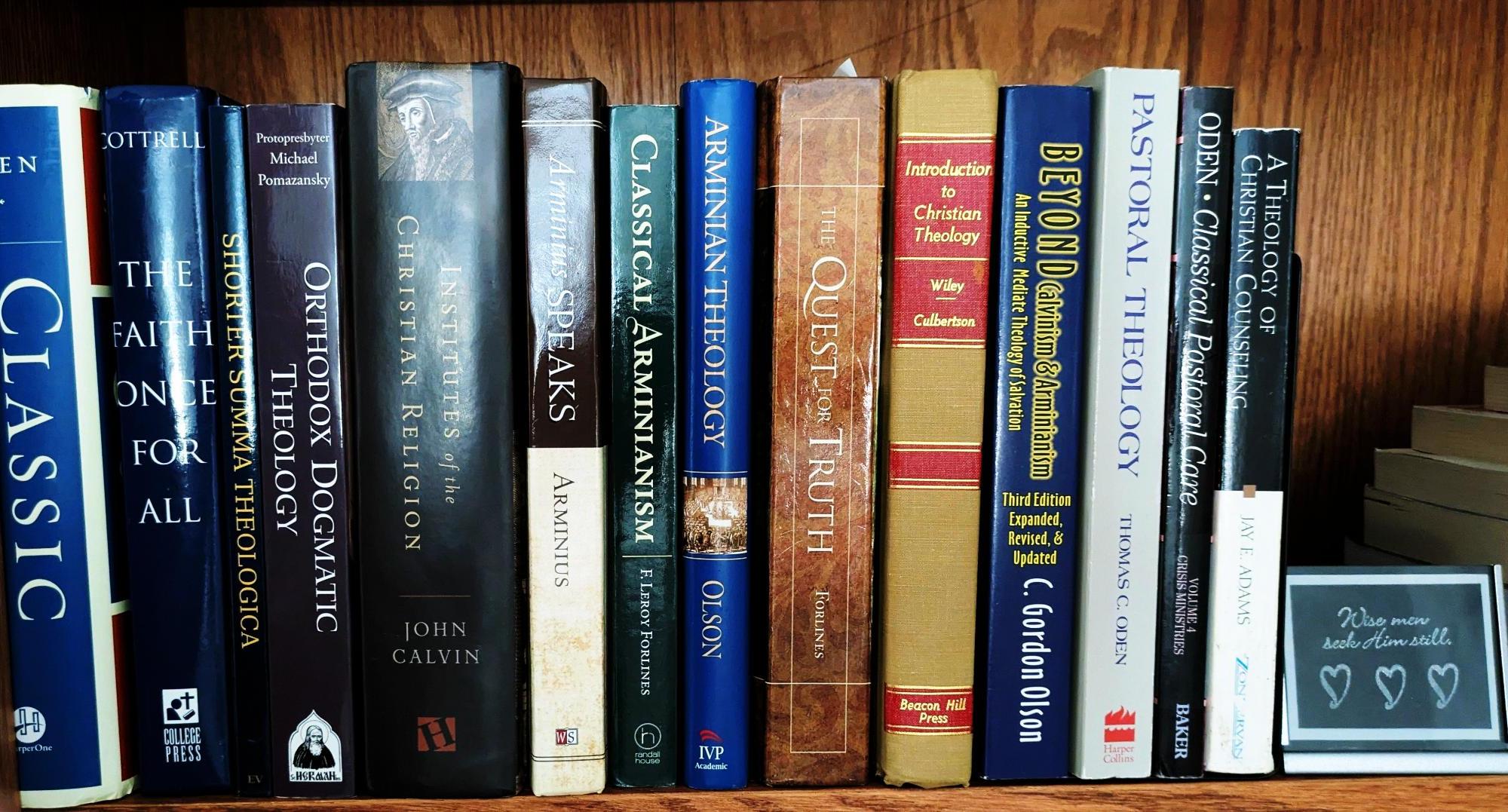
Sometimes I think it will be best to simply recommend a single volume book that stands out. But, other times there are simply so many great works available that it will be more effective to make recommendations by category rather than by single volume. So, with that in mind, we’ll start with a selection of theological volumes from my bookshelf that have been immensely beneficial to me in my spiritual journey.
Real quick, please comment below if you like this kind of post and want to see more!
Classic Christianity
Thomas C. Oden (1931–2016) was an American Methodist theologian who spent much of his career at Drew University. Coming of age in the era of theological liberalism and later disillusioned with the direction of modern theology, Oden became one of the leading voices of the “paleo-orthodox” movement, arguing that the Church should recover the classical Christian faith rather than continually reinvent it according to modern intellectual fashions. His work was shaped particularly by the early Fathers, the ecumenical creeds, and the broad consensus of historic Christianity.
Classic Christianity is a complete systematic theology, which aims to present the whole Christian faith as received, confessed, and lived by the historic Church. This work collects and organizes the teachings of early Christian writers by theological categories, and synthesizes them into a consensual theology of the Great Christian Tradition. The central question of his project was about what the early Christians believed before modern theological divisions and innovations reshaped the landscape, which he hoped to accomplish by recovering what he called the classical Christian consensus expressed in Scripture, the Fathers, the creeds, and the great theologians of the Church.
What I love about this work is how it demonstrates the vast repository of shared doctrines that unite Christians across the great traditions of the Church. So many volumes focus on the minutia of differences that separate the Christian traditions that we risk losing sight of the great body of shared beliefs that exist between us.
Thomas Oden’s works have proven profoundly influential to my own ministry and work.
The Faith Once For All
Jack Cottrell (1938–2022) was an American theologian from the Christian Churches and Churches of Christ who wrote from within the Restorationist Movement. He taught theology at Cincinnati Christian University for nearly five decades and argued that Christians should base their teachings principally on the authority of Scripture rather than on their ecclesial traditions. He writes from within the Restorationist Movement’s distinctive commitment to biblical authority and extensively engages the wider Protestant theological traditions.
The Faith Once For All is a complete systematic theology with the goal of presenting a comprehensive biblical doctrine grounded in Scripture alone. This work’s organizing principle is that “Christians are called to contend for ‘the faith once for all delivered to the saints‘” (Jude 3). Jack Cottrell works on the premise that Scripture’s intended message has been faithfully preserved and can be correctly understood when read in its historical and grammatical context. The rigor of his discipline to eschew the biases of ecclesial tradition in favor of returning to the plain teachings of the Bible comes from his distinctly Restorationist convictions, which reject Church tradition as sufficient for establishing her faith and practice.
What I love about this work that sets it apart from others is the special attention it gives to the biblical foundations of its system. Jack Cottrell asks what the Bible teaches about each question and how Christians should understand them as a coherent whole. And this is an influence I think we need today because we often struggle to believe that the Scripture can speak plainly. But, when we begin to look at what the Bible says, we discover just how accessible its meaning really is to us today.
Shorter Summa Theologica: A Modern Translation of the Compedium of Theology
Thomas Aquinas (c. 1225–1274) was a Dominican friar and one of the great theologians of the medieval Church. He wrote during the thirteenth-century revival of learning, when Christian theology was engaging deeply with the rediscovered philosophy of Aristotle and wrestling with questions concerning faith, reason, nature, and revelation. His Summa Theologiae was written within the theological world of medieval Catholicism and sought to organize Christian doctrine into a coherent whole.
This work is a modern translation of Aquinas’ Compendium of Theology, which was a separate work in which Thomas Aquinas himself sought to present the whole of Christian doctrine in a concise and orderly form. His Compendium shares much of the theological substance and systematic character of his much larger Summa Theologica, it’s not merely an abridgment of that work, and he ultimately left it unfinished. However, what remains provides a remarkably concise window into his own theological method and thought. The Summa itself was one of the most influential theological works in Christian history, organizing Catholic theology around a comprehensive vision of God, creation, humanity, Christ, the sacraments, and redemption.
What I love about Aquinas’ work is it’s organizing principle: “Exitus et reditus” (or “coming forth from God and returning to God”). This expresses the idea of God as the beginning and end of all reality, and it’s where I have anchored my insistence that “all authentic Christian doctrine begins and ends with God.” This is enormously helpful in an age where so many pastors peddle their own brand or niche doctrines. Another attribute of this work that I love is its belief that the Christian faith is rational and orderly, and can be understood in such a manner. The Bible is not only able to be read and understood, as Jack Cottrell argued, but its message can be rationally ordered into a coherent whole. This again is enormously helpful in an age where internet influencers try to proof-text their incoherent and disconnected pet doctrines for personal gain.
Orthodox Dogmatic Theology
Protopresbyter Michael Pomazansky (1888–1988) was a Russian Orthodox theologian, priest, teacher, and later professor at Holy Trinity Orthodox Seminary in Jordanville, New York. His life spanned the Russian Revolution, the upheaval of Soviet rule, and the dispersion of Russian Orthodoxy into the diaspora. Writing from within the Russian Orthodox tradition, Pomazansky’s theology therefore reflects a Church deeply concerned with preserving the faith received from Scripture, the Fathers, the councils, and the liturgical life of the Church amid the intellectual and political upheavals of the modern world.
Orthodox Dogmatic Theology is one of the most widely recognized modern presentations of Eastern Orthodox doctrine. Although, as anyone who spends any significant amount of time engaging the Orthodox community will find out, they are generally skeptical of the systematic methodology characteristic of Western scholastic theology. Nevertheless, Pomazansky organizes the Church’s dogmatic teaching into a systematic and accessible form that I think is very useful to the broader Church. His central concern is not to develop a new theological system, but to articulate what the Orthodox Church has received, confessed, and preserved through Scripture, the Fathers, the Ecumenical Councils, and the Church’s worship and tradition.
What I love about this work as one that was written in the aftermath of the theological upheavals of modernity and from within the Russian Orthodox diaspora, is that it is particularly valuable as an example of Orthodoxy’s effort to preserve and clearly articulate its inherited faith without compromise in the ever-changing modern world. This work is much heavier than most introductions to Orthodoxy, but I also think it’s much better at accurately explaining Orthodoxy’s beliefs because many of the lighter introductions gloss over some of the significant and more controversial beliefs that this work takes the time to cover in detail. I also love Orthodoxy’s sustained focus on spiritual formation, something that many Protestant traditions lack, which this work can help provide the theological foundations for (although “formation” is not principally accomplished in the Orthodox view via theology).
The Institutes of the Christian Religion
John Calvin (1509–1564) was a French lawyer-turned-theologian and pastor who became one of the central figures of the Protestant Reformation. He wrote the Institutes amid the sixteenth-century conflict between Protestant reformers and the Roman Catholic Church, as well as significant disagreements among the reformers themselves. The work developed through successive editions as Calvin’s thought matured, eventually becoming one of the defining statements of Reformed theology.
The Institutes of the Christian Religion is, therefore, to Protestants what Thomas Aquinas’ Summa Theologica was to Catholics. This work also became one of the most philosophically and logically sophisticated systematic theologies available, as John Calvin’s legal mind helped him simultaneously organize and structure this work around both the flow of the Apostles’ Creed and the Biblical story of redemption.
What I love about the Institutes is what I love about Cottrell’s “Faith Once For All” and Aquinas’ “Compendium of Theology”. John Calvin believed, like Cottrell many centuries later, that the Bible was both the highest authority for Christian faith and practice, and could be rightly understood in context to produce the teaching useful for establishing Christian faith and practice. Likewise, he believed, as Aquinas did many centuries before him, that the Christian faith is rational and orderly, and can be understood in such a manner. This combination makes the Institutes useful to everyone who shares these convictions even where there are disagreements within the nuances of his system.
Arminius Speaks
Jacobus Arminius (1560–1609) was a Dutch Reformed pastor and theologian whose objections and contributions came from within, rather than from outside the Reformation. He challenged the emerging “Reformed consensus” associated with Calvinism over controversial positions on predestination, election, limited grace, and human freedom. His challenges to the theological consensus of his time created a controversy that continued after his death and eventually culminated in the Synod of Dort, which was an international church council held in Dordrecht, Netherlands, where Arminian views were rejected and the Canons of Dort (i.e. what eventually were distilled into what we today call “T.U.L.I.P.”) were issued. Nonetheless Arminius’ views proved influential across the broader Protestant tradition and are seen in churches of all kinds even to today.
Arminius Speaks is the first work on this list that isn’t a true systematic theology, but rather, selects portions of Arminius’s massive three-volume Works and arranges them in an orderly fashion to introduce readers to his theology. Much like Thomas Aquinas’ Summa Theologica, Arminius’ Works is too large and inaccessible to be useful to most people. So I recommend this volume as one of the most accessible single volumes to understanding Arminius’ doctrine.
What I love about this work is how it handles questions about predestination, election, and salvation with real rigor. These are weighty questions that need proper handling because they really do matter to the lived experience of the Christian faith, and Arminian theology wrestles with these questions in a serious manner that provides thoughtful alternatives to the Calvinist position.
Classical Arminianism
F. Leroy Forlines (1926–2020) was a Free Will Baptist theologian and professor whose work represents a particularly rigorous form of classical Arminian theology. What’s unique about his work is that he was writing from within the American evangelical movement during a time when Arminian theology had lost much of its theological and academic rigor, and had been reduced to superficial caricatures of “free will.” Forlines sought to recover the much more sophisticated theological tradition represented by Arminius and his successors and seriously engaged with the broader Reformed theological tradition.
Classical Arminianism is a systematic theology that narrowly focuses on soteriology (i.e. the doctrine of salvation). Arminius had no need for a complete systematic “Arminian” theology because he accepted nearly everything from Calvin’s “Institutes”, which is something that often gets overlooked. The Canons of Dort later narrowed the focus of the dispute down to five essential points: “total depravity, unconditional election, limited atonement, irresistible grace, and the perseverance of the saints.” There were many other points addressed, but these eventually became distilled into what we now know as T.U.L.I.P. This book, therefore, narrowly focuses on those core disputes to distill a distinctly Arminian systematic theology of salvation so that Arminians can build their understanding of salvation with true rigor.
What I love about this work is precisely its rigor. Forlines deals with the relevant questions and puts them into their biblical focus. He shows how the Biblical revelation of God liberates him from some of the horrifying implications about him that arise from Calvinism’s errors. And he argues these points with real rigor.
Arminian Theology
Roger E. Olson (born 1952) is an evangelical theologian and longtime professor at Baylor University’s George W. Truett Theological Seminary. A Baptist and Mennonite theologian with experience across several Christian traditions, Olson wrote Arminian Theology in the context of a renewed evangelical debate over Calvinism and Arminianism. His central concern is to correct what he considers widespread misconceptions about Arminian theology and to demonstrate that classical Arminianism is a historic, grace-centered Protestant theology rather than simply the theological opposite of Calvinism.
Arminian Theology is not a systematic theology, but a theological defense, which aims to address various misconceptions and rebut arguments made against Arminian theology. One of the key defenses of this volume is that Arminianism is not the “opposite of Calvinism.” He presents it as among the branches of the Reformation, arguing that Arminianism did not seek to break away from the Reformation, but rather, to actually continue it, which is what the historical record shows.
What I love about Olson’s work is its attention to anchoring Arminianism within both the Reformed and broader Christian traditions. He demonstrates that it’s not a separate and opposite theological system from Calvinism, but a correction of the reformed tradition that is firmly rooted in the beliefs of the historic Christian faith. Far too often Protestants fall prey to the idea that our faith represents modern innovations when, in reality, the whole point of Protestantism was to reject Catholicism’s innovations and return to the foundation of God’s word. So Olson’s work helps Arminian Christians understand themselves in light of the historic Christian tradition.
Quest for Truth
Forlines wrote Quest for Truth from within the Free Will Baptist and broader evangelical Arminian traditions, but his theological interests extended well beyond these denominational boundaries. He wrote this systematic during a chaotic period when American evangelicalism was wrestling with questions of biblical authority, religious skepticism, and the relationship between faith and reason. He met this chaos by combining careful biblical exegesis with piercing philosophical reflections to form a distinctly coherent Christian worldview.
The Quest For Truth is a complete systematic theology that properly sits beside bigger works like Calvin’s Institutes and Aquinas’ Summa Theologica. This systematic theology covers the whole field of Christian doctrine in order to create a unified and coherent Christian worldview.
What I love about this work is precisely its focus on creating a distinctly Christian worldview that is capable of holding up to today’s challenges. What makes this work unique is that Forlines spends considerable time establishing the foundations of knowledge (i.e. epistemology), which allows him to build a robust worldview framework that is capable of holding up against skeptical criticism from outside the Christian faith. And, as such, it’s the only work on this list that I would describe as being “missions-aware”, meaning that it has real missionary value. I used it for ten years on the mission field to teach theology in a manner that equipped our members to engage the challenges of their world, which is a real testament to this work’s value that it was able to transcend the American cultural context in which it was written and be useful in other contexts.
Introduction to Christian Theology
Henry Orton Wiley (1877–1961) was a prominent educator and theologian in the Church of the Nazarene and one of the major architects of twentieth-century Wesleyan-Arminian theology. He wrote during a period when Wesleyan and holiness churches were developing formal theological education and responding to both modern theological liberalism and the growing influence of fundamentalism. His theology, therefore, combines classical Christian doctrine with the Wesleyan emphasis on grace, sanctification, and Christian holiness.
The Introduction to Christian Theology is an introductory systematic, which is much shorter and less technical than his three-volume Christian Theology, but follows essentially the same framework. Its purpose is to introduce readers to the major doctrines of the Christian faith in an orderly and systematic way. This work has been used in Bible colleges, Wesleyan institutions, and lay theological education. Being from the Wesleyan tradition, which arose out of the Arminian branch of the Reformation, this work represents a concise organization of John Wesley’s theology, which not only informed the Methodists, but also other denominations like free-will Baptists, restorationists, Nazarenes, Pentecostals, and Charismatics.
What I love about this work is its introductory accessibility. I have used this work many times to orient myself when engaging various theological questions because it gives the broad framework of the issues.
Beyond Calvinism and Arminianism
Gordon C. Olson was an American theologian and engineer whose theological work grew out of a personal struggle with questions surrounding salvation, discipleship, human freedom, and God’s sovereignty. His engineering background strongly influenced his approach: he subjected theological assumptions to sustained biblical and philosophical analysis, particularly challenging deterministic understandings of divine sovereignty. His work belongs to the broader free-will/Arminian stream while attempting to move beyond the conventional Calvinist-Arminian categories by examining the philosophical assumptions underneath them.
Beyond Calvinism and Arminianism is another systematic theology of salvation. This volume does the work that so many who refuse the labels of both “Calvinism” and “Arminianism” simply refuse to do. And, as a result, it’s highly philosophical and presses readers to examine the underlying definitions of sovereignty, freedom, foreknowledge, and moral responsibility rather than assuming the categories inherited from either side of the debate. Gordon essentially argues that God’s creation of a moral universe populated by genuinely free creatures was a genuinely sovereign act. And he argues that God’s sovereignty consists not in meticulously determining every event but in wisely governing creation toward His ultimate purposes. Because authentic love and obedience require real freedom (i.e. “libertarian freedom”), God enables every person through grace to respond to Him without coercing that response. So, divine foreknowledge perfectly comprehends future free choices without causing them, allowing God to accomplish His redemptive plan while preserving genuine human responsibility. The nuances between what Gordon presents and the traditional categories of the Calvinist and Arminian debate are very fine, so it requires careful reading, but is well worth the effort.
What I love about this book is how it manages to take the most natural reading of Scripture without getting sucked into the traditional categories of these questions. What emerges is something that I think is much more natural to the reading of Scripture, and the philosophical rigor of the arguments that Gordon makes help create a genuinely robust view that I think benefits the whole discussion.
Pastoral Theology
Oden’s Pastoral Theology emerged from the same twentieth-century theological crisis that shaped his broader Classic Christianity work. At a time when pastoral ministry was increasingly influenced by psychology, management theory, therapeutic models, and contemporary leadership theory, Oden argued that the Church already possessed a rich pastoral tradition developed through centuries of Christian experience. His response was not to reject contemporary knowledge altogether, but to recover the biblical and classical understanding of the pastor as shepherd, teacher, physician of souls, and steward of God’s mysteries.
Pastoral Theology is obviously not a systematic theology, but is the practical application of theology to pastoral ministry. This work eschews the modern pastoral methodologies of psychology and management theory, and emphasizes the biblical and historic church traditions of pastoral ministry, arguing that these are more precisely honed to accomplishing the purpose and mission of pastoral ministry.
What I love about this work is it’s unapologetic love for the Church’s pastoral tradition in the face of the smugness of modern science. Oden argues that pastors are neither CEOs, nor therapists, nor political activists, but instead, are shepherds, teachers, physicians of the soul, and stewards of the mysteries of God. I think we desperately need to recover this vision in the Church today because we are losing our distinct value as we try to offer just another brand of therapy or political activism. Every time you see your favorite pastor get sucked into today’s political tribalism, you’re seeing a pastor who lost the vision of ministry that Oden articulates here.
Classical Pastoral Theology: Volume 1
Oden writes Classical Pastoral Theology (volume one) as a mature effort to recover the ancient Christian tradition of cura animarum, or the “care of souls.” Rather than beginning with modern theories of leadership, therapy, or counseling, Oden looks backward to the pastoral wisdom of the historic Church, particularly the Fathers and the classical pastoral writers. The work belongs to his broader paleo-orthodox project, and moves from the conviction that the Church’s accumulated wisdom should be recovered rather than discarded simply because modernity has supposedly moved beyond it.
This volume is a historically grounded pastoral theology organized around the classical Christian tradition of the care of souls. It asks and answers two central questions: “What has the historic Church believed pastoral ministry is”, and “how should pastors faithfully carry out that vocation?” The organizing principle of this work sees “the pastor as physician of souls”, and treats his work as being primarily about proclaiming the truth, administering grace, diagnosing spiritual sickness, and guiding souls toward holiness. While Oden’s “Pastoral Theology” introduces the discipline of pastoral theology, this work offers a historical retrieval of the classical tradition that forms the foundation for pastoral theology. The former is more practically useful, the latter is more academically useful.
What I love about this work is its attention to a core subject that is almost entirely neglected today in pastoral training and development: “the care of souls.” Although Oden doesn’t make this point, my own tradition sees “pastors” and “elders” as interchangeable, and recommends that pastors be older. I agree with this because younger men are still laying theological foundation. Older men, however, have laid their theological foundations and can turn their attention to the weightier matters of caring for people’s souls. They also have more life experience by which to appreciate the importance of these matters. This book stands out as one that really focuses on the care of souls in a way that I believe all pastors need to learn.
A Theology of Christian Counseling
Jay E. Adams (1929–2020) was a Reformed theologian, pastor, seminary professor, and pioneer of the modern biblical counseling movement. He wrote in reaction to the growing influence of secular psychology within twentieth-century Christian counseling, arguing that the Church should develop its understanding of human problems and pastoral care from Scripture and Christian theology. His work helped launch what became known as the nouthetic or biblical counseling movement, though his strongly Reformed framework and sharp opposition to competing approaches have also made his work controversial.
This volume attempts to construct a distinctively biblical counseling theology to counter the dominance of secular psychology within Christian ministry. Adams asks, “how should the Church help people change?” His organizing principle is that Christian counseling must be built upon Christian theology.
What I love about this book is its conviction about the primacy of Scripture in counseling. He believes that there is a place for the practice of “Christian counseling” in the Church, but insists that it must be distinctly Christian. Whereas Oden would reject the approach of counseling altogether, Adams recognizes its utility and seeks to subordinate it to the authority of God’s word. This book is, as I said, thoroughly reformed, and it presses reformed theology hard, so it requires a willingness to read through and interpret positions, but I think it still provides a useful framework for all Christian counseling.
My Final Thoughts
I entered formal ministry when I was 21 years old. I’m now going on 20 years of ministry leadership. And I still remember the advice that one of my college Bible professors gave me: “longevity in ministry requires reading deep.” His point was that it’s impossible to coast through ministry from what you gain during a finite period of even rapid growth like most people experience during seminary or the like. You will have to continue to grow even when that growth is costly, difficult, or hard. These works have helped me to continue growing over the years, with some of them being works that I have only recently begun studying, and others being pillars from almost the very beginning.
No work on any book review list that I write will ever come close to the influence of the Bible in my life. But it’s a mistake to think, especially for ministers, that we do not need the grace that God has distributed throughout the body of Christ over time. I truly believe the Holy Spirit has been at work throughout the body to “equip the saints for the work of ministry” and to “build up the body of Christ, until we all reach unity in the faith and in the knowledge of God’s Son, growing into maturity with a stature measured by Christ’s fullness” (Eph 4:12–13). We benefit from what the Spirit has done among those who came before us, even as broken and imperfect as they were, and we continue that work when we humbly receive what the Spirit has done in them and carry that growth forward.
Life is a spiritual journey that is shaped by those influences that change our thinking, that guide our emotions, and that give us our vision.
Share your favorite theological books in the comments and let me know what you think about these books!

