When Abundance Becomes Idolatry
There are few biblical cities whose sins are more famous than Sodom.
Yet when Ezekiel describes Sodom’s wickedness, he emphasizes something unexpected, describing, not the sin for which Sodom is most commonly remembered, but instead, something that ought to make prosperous societies uncomfortable:
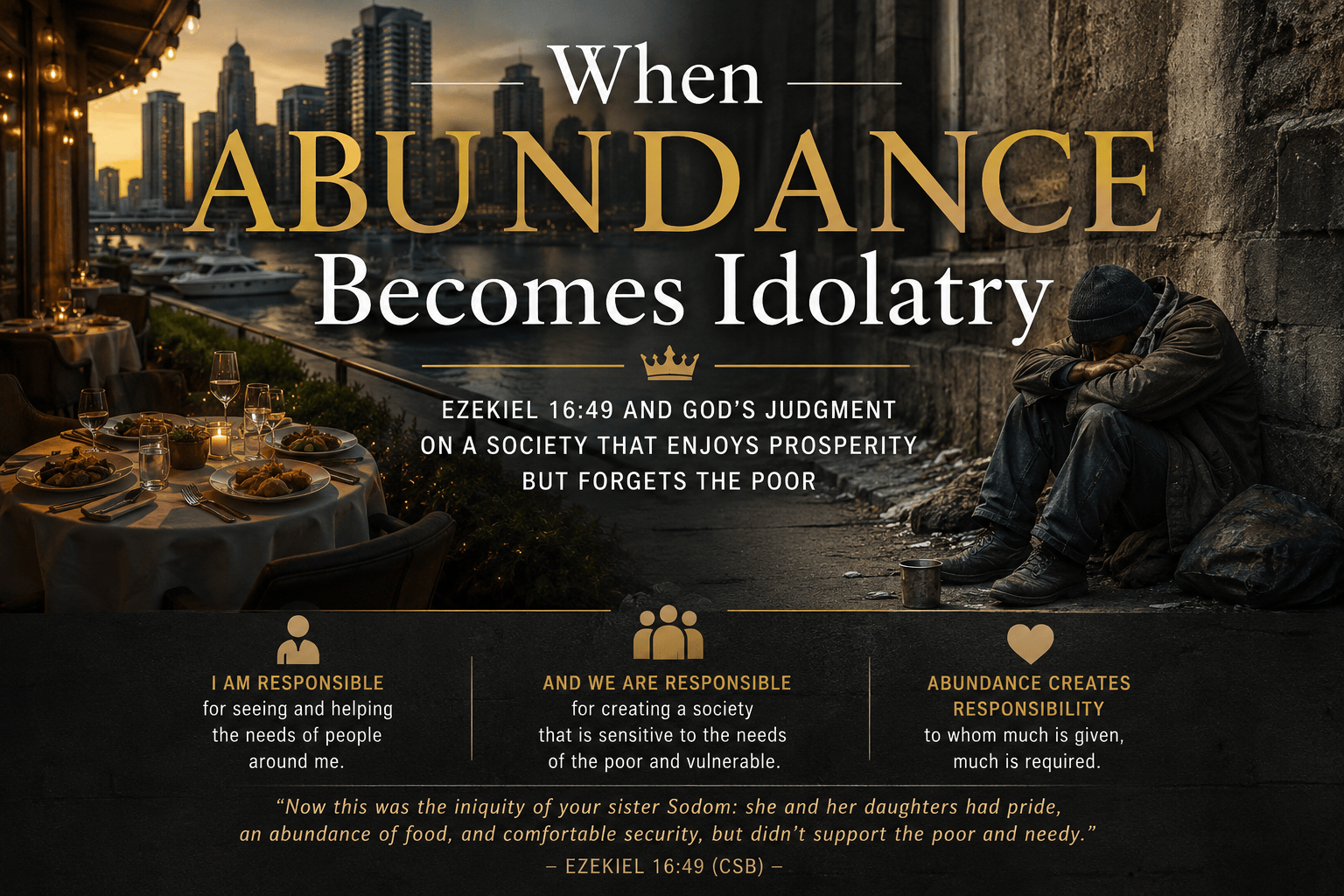
Ezekiel 16:49 (CSB) — “Now this was the iniquity of your sister Sodom: she and her daughters had pride, an abundance of food, and comfortable security, but didn’t support the poor and needy.”
Ezekiel doesn’t condemn abundance itself, but says something that should challenge us at a much deeper level: Sodom’s problem was not simply that she had plenty, but that she had plenty while the poor and needy remained without what they needed.
In this way her abundance became a moral indictment.
Wealth isn’t morally neutral
We have been taught to think of wealth as morally neutral. A person has more, another person has less, and the difference is treated primarily as an economic fact without any moral implications. But this isn’t a feature of Christian doctrine.
The prophets do not allow us to think that way.
Ezekiel explicitly connects Sodom’s prosperity to her arrogance that failed to strengthen the poor. Her wealth wasn’t simply a blessing that she was free to enjoy without regard for others, but actually created moral responsibility towards the poor and vulnerable.
Here we are forced to distinguish what Ezekiel is saying from what other secular and political philosophers of our time are saying: he isn’t saying that the wealthy are universally responsible for every person who has less than them, nor that it’s inherently immoral to possess more than someone else. There are many voices today that might at-first sound like they resonate with Ezekiel’s message, but they all ultimately fail to live up to what Ezekiel is teaching.
The basic principle is clear:
Wealth creates moral obligations in God’s sight toward those who lack.
The existence of hungry people around me changes the moral meaning of the food on my table. The existence of someone without adequate clothing changes the moral meaning of the clothes in my closet. The existence of people who cannot meet the demands of life’s necessities changes the moral meaning of the luxuries I indulge. Put simply, to whomever much is given, much is required.
The sin of enjoying abundance without responsibility
One key problem arises when Ezekiel’s message gets compressed into merely commanding individual charity. The question wasn’t whether the rich in Sodom occasionally performed charitable acts of kindness, as if our moral obligation to the poor and vulnerable can be relieved by some minimum giving threshold, but rather, the issue at hand is about the character of their society.
We must see this clearly to guard against the errors of hyper-individualism: God doesn’t only look at our individual vices anymore than he only looks at our community-sins. God holds both in balance. He will not condemn the righteous with the unrighteous, nor will he excuse the individual from any responsibility for the actions of their community. And in this oracle, God is judging Sodom at the national level. Therefore, it’s necessary that our interpretation make sense of God’s judgments against Sodom as a societal-whole.
Sodom’s problem was that she created a society in which prosperity, comfort, and security existed without-question or second-thought alongside the neglect of the poor and vulnerable. Her lack of concern for the poor was, in Ezekiel’s words, arrogant. Therefore, we are morally responsible in God’s sight if we create a society that is indifferent towards the needs of the poor.
Therefore, the question raised by our principle is much larger in scope:
“What kind of society are we creating with the resources God has entrusted to us?”
Prosperity can become idolatry
Prosperity often feels like evidence of God’s favor, which is why wealth is particularly dangerous. When we have enough food, comfortable homes, economic growth, technological advancement, and increasing wealth, it’s easy to assume that we must are enjoying God’s unqualified favor and approval. And, in this assumption, we can fail to examine ourselves with reverence towards the Lord.
The reality that Ezekiel’s oracle reveals to us is that material success can coexist with profound moral failure. And, in fact, prosperity can sometimes conceal that failure. The comfortable person may never see the person who cannot afford food. The secure society may never notice the vulnerable. The wealthy may interpret their abundance as evidence of their virtue rather than as a stewardship entrusted to them.
The prophets repeatedly challenge these illusions.
A society cannot measure its righteousness merely by the size of its economy. We have a moral obligation before God to notice the poor. We have a moral obligation to take the needs of the vulnerable into account.
Therefore, the nations are responsible to ask:
What happens to the people who cannot protect themselves?
This is why Ezekiel’s accusation matters
Ezekiel does not say that Sodom was wicked because she possessed abundance. He says she was wicked because her abundance existed alongside her neglect of the poor and needy.
That distinction is key.
Christianity doesn’t regard every form of wealth as evil. Scripture teaches that material blessings are given by God for our enjoyment. But, Ezekiel’s oracle also teaches us that God’s blessings are not free from moral responsibility. Wealth simultaneously creates both personal and communal responsibility. I am responsible for the people God places within my reach. We are responsible for the society we create together. And neither responsibility excuses us from the other.
Therefore, Ezekiel teaches us that there is real danger in abundance without love.

