Losing the gospel’s plot
I saw this post that ached my heart and stuck with me for a minute.
When you realize the gospel was never about cutting off sin, it’s about loving God so much you no longer want to sin.
@Banacubana_
I want to be very clear that this isn’t a comment on this user’s faith or practice. I actually think this user has beautifully represented the direction most Protestant churches are moving in these days. He is merely presenting a modern take on hamartiology (i.e. the nature of sin).
Protestantism is slowly drifting away from the idea that we are at war with our sin. I think this comes from one of our strengths, which frames the gospel in relational terms. But, sin is slowly being pressed into merely being a question of one’s love; if I love God, I won’t do what displeases him. Again, I want to be clear that this isn’t false doctrine because love is one of the strongest motivations in Christian life for personal holiness.
There is something fundamentally true about what this author has written. The good news of God’s Kingdom is about being reconciled to God, and, in this new relationship with God, we no longer desire the sins of our former way of life.
However, our love for God is not just about desiring God more than sin. Our love for God is actually why we are at war with sin and must cut off sin. Those who love God are marked by their diligence in cutting off sin precisely because God is holy and darkness cannot have any fellowship with him.
The apostle Paul put it like this:
Colossians 3:5–10 (CSB) — 5 Therefore, put to death what belongs to your earthly nature: sexual immorality, impurity, lust, evil desire, and greed, which is idolatry. 6 Because of these, God’s wrath is coming upon the disobedient, 7 and you once walked in these things when you were living in them. 8 But now, put away all the following: anger, wrath, malice, slander, and filthy language from your mouth. 9 Do not lie to one another, since you have put off the old self with its practices 10 and have put on the new self. You are being renewed in knowledge according to the image of your Creator.
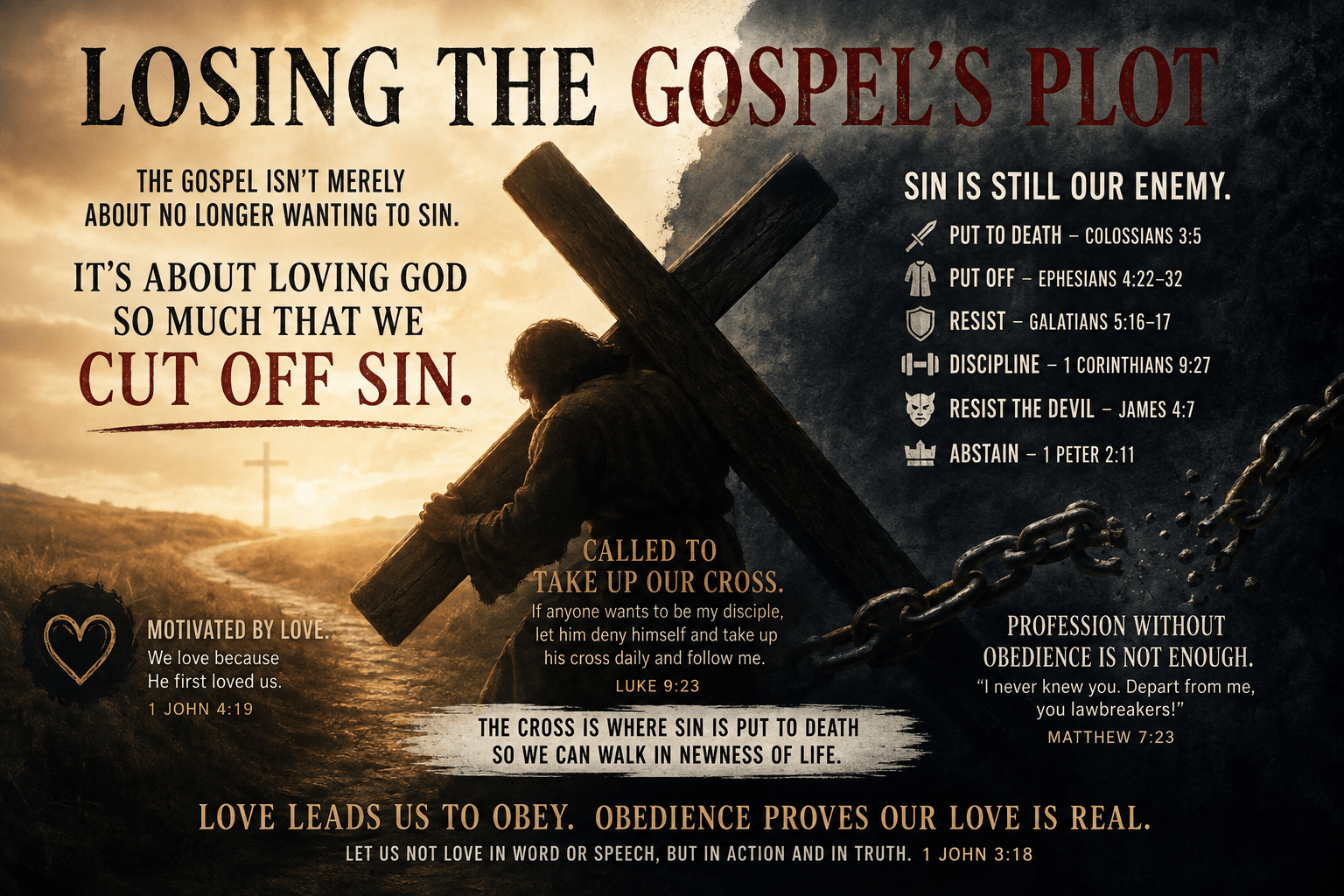
Christians put to death the sins that belong to our earthly nature precisely because we have put on the new self and are being renewed according to the image of our Creator. This is why we are repeatedly told by Paul to put off specific sinful behaviors (Eph 4:22–32), to resist the desires of the flesh (Gal 5:16–17), and to discipline our bodies (1 Cor 9:27). Likewise, Jesus teaches us to deny ourselves and take up our cross (Lk 9:23), James teaches us to resist the devil (Jas 4:7), and Peter teaches us to abstain from sinful desires that wage war against our souls (1 Pet 2:11).
I think the apostle John expressed the relationship between love and purity well:
1 John 3:1–3 (CSB) — 1 See what great love the Father has given us that we should be called God’s children—and we are! The reason the world does not know us is that it didn’t know him. 2 Dear friends, we are God’s children now, and what we will be has not yet been revealed. We know that when he appears, we will be like him because we will see him as he is. 3 And everyone who has this hope in him purifies himself just as he is pure.
Again, I believe that the apostle Paul sets the relationship between the believer and their sin in its proper place in the gospel story:
Romans 8:1–5 (CSB) — 1 Therefore, there is now no condemnation for those in Christ Jesus, 2 because the law of the Spirit of life in Christ Jesus has set you free from the law of sin and death. 3 For what the law could not do since it was weakened by the flesh, God did. He condemned sin in the flesh by sending his own Son in the likeness of sinful flesh as a sin offering, 4 in order that the law’s requirement would be fulfilled in us who do not walk according to the flesh but according to the Spirit. 5 For those who live according to the flesh have their minds set on the things of the flesh, but those who live according to the Spirit have their minds set on the things of the Spirit.
The cross is the means by which we mortify death in our life so that we can walk by the Spirit in the newness of life. The cross is where sin is put to death in our life. And, lest we flatten the cross into mere symbolism, Jesus commanded that we pick up the cross ourselves, which Paul explained entails “putting off” our former way of life. The point is that the Christian, being motivated by love, embraces the cross and actively puts off the sinful deeds that their flesh desires.
We have been in quite a few Christian communities over the years. And we have met some very kind-hearted and loving people. But we have also noticed a steady drift away from preaching against sin. We have been in churches where we never once heard a sermon plainly calling Christians to put away sin. In these cases, every call to holiness was reframed around love for God. There was a serious devotion to loving God, but an equally transparent reticence to call people to “deny themselves, pick up their crosses, and follow Jesus” in the clearest sense of that calling. The result seems to be an emerging theology that places sin in the background and emphasizes relationship, heart, and intention. And that is dangerous.
So I think it’s necessary to let Jesus speak here in his own words so we understand what’s at stake if we lose the plot here:
John 15:9–12 (CSB) — 9 “As the Father has loved me, I have also loved you. Remain in my love. 10 If you keep my commands you will remain in my love, just as I have kept my Father’s commands and remain in his love. 11 “I have told you these things so that my joy may be in you and your joy may be complete. 12 “This is my command: Love one another as I have loved you.
Matthew 7:21–27 (CSB) — 21 “Not everyone who says to me, ‘Lord, Lord,’ will enter the kingdom of heaven, but only the one who does the will of my Father in heaven. 22 On that day many will say to me, ‘Lord, Lord, didn’t we prophesy in your name, drive out demons in your name, and do many miracles in your name?’ 23 Then I will announce to them, ‘I never knew you. Depart from me, you lawbreakers!’, 24 “Therefore, everyone who hears these words of mine and acts on them will be like a wise man who built his house on the rock. 25 The rain fell, the rivers rose, and the winds blew and pounded that house. Yet it didn’t collapse, because its foundation was on the rock. 26 But everyone who hears these words of mine and doesn’t act on them will be like a foolish man who built his house on the sand. 27 The rain fell, the rivers rose, the winds blew and pounded that house, and it collapsed. It collapsed with a great crash.”
Notice that Jesus’ teaching starts with and operates through love. He tells us that those who live out his command will remain in his love. And he tells us that his command is that we should love one another in the way that he has loved us. But, the apostle John doesn’t allow us to flatten “love” into merely the heart, intent, or relational terms. He says “let us not love in word or speech, but in action and in truth” (1 Jn 3:18). Our love must be real and true. And our flesh is going to rise up in hatred, which we must cut off if we are going to express love in action and in truth.
Then Jesus says that the mere profession of relationship to him is not enough. There are going to be people who think they know Christ, but his answer will be “Get away from me, because I don’t know you!” He then tells us that only those who do the will of the Father know him, and, again, to make sure we don’t miss what it means to “do the will of the Father,” he refers us back to keeping his teachings. And his teachings include things that pertain to “cutting off sin,” like “gouging out the eye that causes you to stumble” and so forth.
I think we can know that we have retained the gospel story with respect to sin when we talk about sin the way the Bible talks about sin. Our preaching should call us to resist sin and cut it off from our lives. Our teaching should equip believers for precisely this purpose. And this should all be properly framed by love within our relationship with God.

