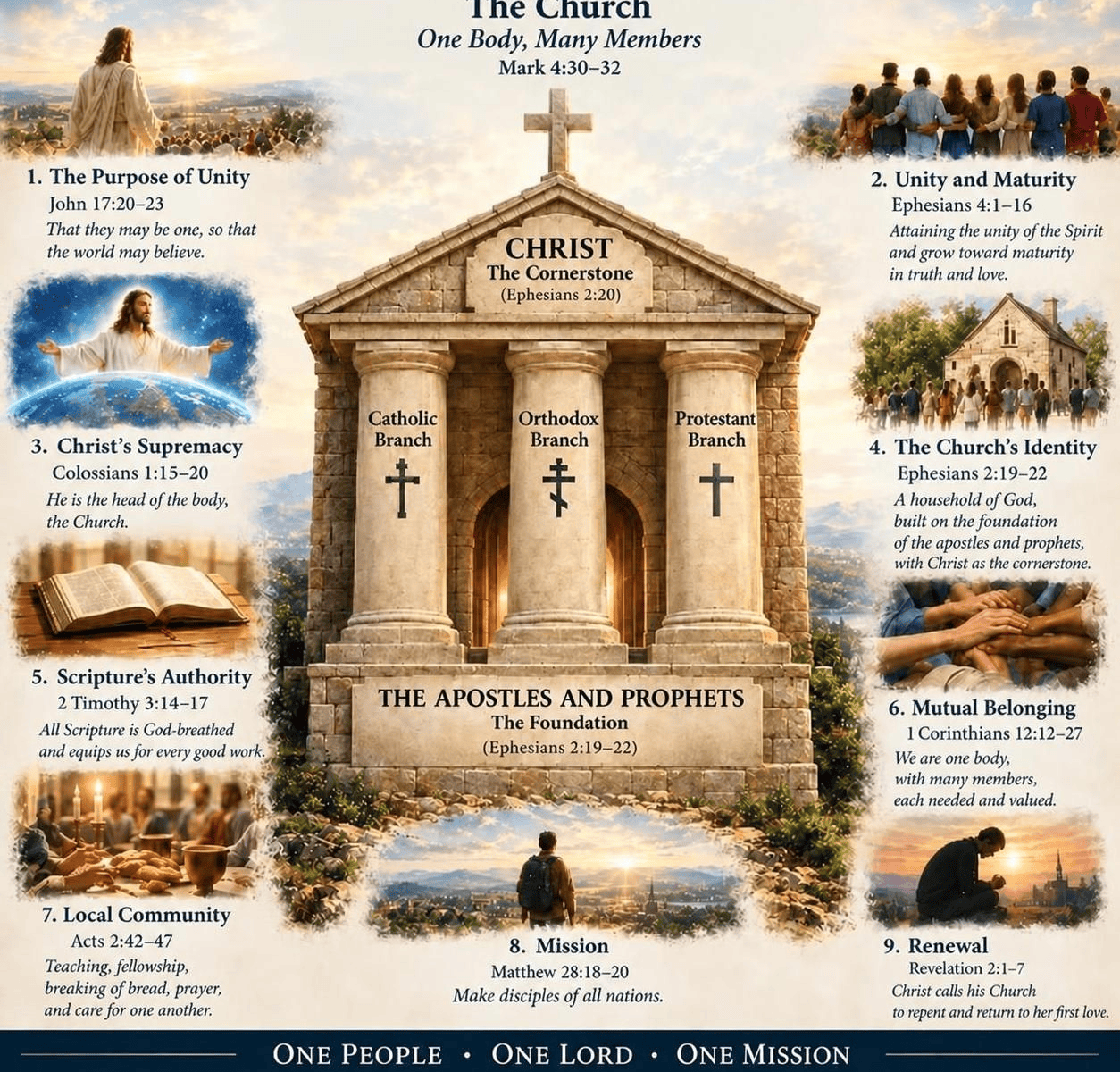
As the hour of Jesus’ crucifixion drew near, he prayed that we would “all be one… so that the world may believe that you have sent me” (John 17:2). Then Peter admonishes us, saying “all of you, have unity of spirit, sympathy, love for one another, a tender heart, and a humble mind” (1 Peter 3:8). Likewise, John reminds us of the Lord’s core message, saying “this is the message you have heard from the beginning, that we should love one another” (1 John 3:11), and also records from his great vision how he “looked, and there was a great multitude that no one could count, from every nation, from all tribes and peoples and languages, standing before the throne and before the Lamb, robed in white, with palm branches in their hands” (Revelation 7:9).
One of the most sobering apostolic injunctions for Christian unity comes from Paul:
Ephesians 4:1–6 (NRSV) — 1 I therefore, the prisoner in the Lord, beg you to lead a life worthy of the calling to which you have been called, 2 with all humility and gentleness, with patience, bearing with one another in love, 3 making every effort to maintain the unity of the Spirit in the bond of peace. 4 There is one body and one Spirit, just as you were called to the one hope of your calling, 5 one Lord, one faith, one baptism, 6 one God and Father of all, who is above all and through all and in all.
Are we leading a life that’s worthy of the calling we’ve received from the Lord Jesus Christ?
This has been something that’s weighed heavily upon my heart since the beginning of my ministry. Why are Christians so divided? And why do our descriptions of what it looks like to be Christian sound so foreign to Jesus’ own descriptions? These are the kinds of questions that I want to deal with here today. Just a heads up that this post isn’t going to be tailored towards a shallow or casual read. We’re going to look closely at what the Bible teaches about unity so that the authority of God’s word can establish what ought to be our faith on this matter.
The Mustard Tree: Unity as a Living Reality
Mark 4:30–32 (NRSV) — 30 He also said, “With what can we compare the kingdom of God, or what parable will we use for it? 31 It is like a mustard seed, which, when sown upon the ground, is the smallest of all the seeds on earth; 32 yet when it is sown it grows up and becomes the greatest of all shrubs, and puts forth large branches, so that the birds of the air can make nests in its shade.”
~ ~ ~
Jesus’ parable of the mustard seed offers a striking image for understanding the nature and unity of the Christian Church. The kingdom of God begins as something small, but it takes root, and grows into a tree that shelters all kinds of life.
What’s important to point out that any reading of this parable that could possibly be useful for Jesus’ stated aim of understanding the Kingdom of God must make four essential observations:
First, there is one root, which is Jesus Christ (cf Rom. 11:18b).
Second, the branches are not imaginary but real. From the Church’s beginnings, different members of the body have always struggled to understand and accept each other precisely because they are different (cf Rom. 11:17-18a; 1 Cor. 12:12-20). The differences between branches are not superficial. Our history matters. Our doctrine matters. Just like any living tree, the Church has many kinds of branches. Trees have vegetative branches, reproductive branches, scaffolding branches, lateral branches, and even twigs. Each has a real function, a real form, and a real place, but none can imagine itself to be the whole tree. The Church in her nature is like this, with many different branches.
Third, branches can be healthy or unhealthy without ceasing to be branches. A branch can grow crooked. A branch can overgrow. Or a branch might be diseased or might not produce as much fruit as it should. Yet, so long as it remains connected to the tree, and until it’s removed by the Gardener (cf John 15:6), it remains a branch connected to the life of the whole tree. And, just as each branch of a tree must maintain it’s own structural integrity because its life is endangered if that structural integrity is compromised, so our great ecclesial institutions must also have real and practical internal unity for them to live and bear fruit. Their traditions and structures are beneficial, but they mustn’t think that these make them the whole tree in themselves.
Fourth, by virtue of being branches, no one branch is the whole tree (cf Mark 4:32). Some branches are older than others. And some branches are load-bearing ones that can bear the weight of storms and support the structural integrity of the tree. But the are still all branches of the tree.
Christian unity is meant to be understood like this parable. Trees develop strong branches, weaker branches, fruit-bearing branches, and peripheral growth, and, although the growth of the tree’s branches are not uniform, they all draw their life from, and are established by, the same root. So we all share in the whole life of the tree.
In the same way, our unity is grounded in the shared life of Christ, who forms, shapes, and establishes us.
For the sake of length, I’m not going to go into Jesus’ allegory of the vine and branches, but it’s necessary to note that the image of the mustard tree must also be understood alongside the Lord’s teaching that those branches which do not abide in him may be removed (see John 15:6). This means that the presence of diversity within the visible Church doesn’t suggest that all teaching is equally faithful, nor that all developments within Christian tradition are healthy. Scripture consistently teaches that God purifies his people through correction, repentance, reform, and even judgment. This means that recognizing the many branches of the Church as sharing in the same life in Christ does not eliminate the responsibility to test teachings, to correct error, or to guard the gospel from distortion. This is an important distinction that I want to make here because unity does not eliminate discernment, but instead, actually requires right-judgment. Therefore, we recognize that branches can be removed from the tree. But that is a sacred work of God alone!
Paul on Unity: The Root and the Building
1 Corinthians 1:10–13 (NRSV) 10 Now I appeal to you, brothers and sisters, by the name of our Lord Jesus Christ, that all of you be in agreement and that there be no divisions among you, but that you be united in the same mind and the same purpose. 11 For it has been reported to me by Chloe’s people that there are quarrels among you, my brothers and sisters. 12 What I mean is that each of you says, “I belong to Paul,” or “I belong to Apollos,” or “I belong to Cephas,” or “I belong to Christ.” 13 Has Christ been divided? Was Paul crucified for you? Or were you baptized in the name of Paul?
~ ~ ~
Paul’s discourse on unity and division in 1st Corinthians chapters 1–3 is very instructive. The Corinthians weren’t dividing over trivial matters. Their differences were substantive. Their differences were reinforced by the traditions that were developing out of influential and authoritative leaders in the Christian community. Using the controlling metaphor of the mustard tree, these were the tender shoots that would one day grow into the major branches of the tree. Yet, despite their growing differences, Paul urges them in the name of the Lord Jesus Christ towards unity. He refused to accept division as normative for Christian life. So we too, if we are going to carry forward the apostolic faith, cannot accept division as normal.
What Paul wrote raises two questions: first, what kind of unity is meant, and second, what kind of division is forbidden?
Paul defines unity as being “united with the same understanding and conviction“, which further begs another question about what kind of understanding should we have? We might assume he’s referencing “dogmatic understanding“, but there’s no hint of that throughout his arguments in chapters 1-3. Instead Paul explains that “we have received not the spirit of the world, but the Spirit that is from God, so that we may understand the gifts bestowed on us by God“ (1 Corinthians 2:12, NRSV). He then concludes, saying “let no one boast about human leaders. For all things are yours, whether Paul or Apollos or Cephas or the world or life or death or the present or the future—all belong to you, and you belong to Christ, and Christ belongs to God” (1 Corinthians 3:21–23, NRSV).
The same-understanding that Paul is calling for is the understanding that we all belong to Christ, and therefore, the leaders God appoints in the Church must not become the basis of either our unity or division. This same principle appears in Romans: “who are you to pass judgment on servants of another? It is before their own lord that they stand or fall. And they will be upheld, for the Lord is able to make them stand” (Romans 14:4, NRSV). The principle that we learn here is that unity begins with belonging. When we frame one another primarily as those who belong to the Lord, we then have the foundation necessary for unity in diversity. This is what Jesus did when he was with the disciples. He kept them together by accepting them.
After defining unity in view of our belonging to the Lord, Paul then defines division as “rivalry,” crystallized in statements like “I belong to Paul” or “I belong to Apollos”, and strikingly, even “I belong to Christ.” The division Paul condemns is the inverse of the unity he commends; we are not meant to belong to Christ against one another, nor to treat our particular leaders or traditions as rival trees rather than as branches serving the same root.
The details of Paul’s discourse are important. He acknowledges that Christians may build poorly on that foundation. Some teaching will endure; some will not. Some theology is wood, hay, or straw – real error – but not foundation-destroying error. The fire will test it and some loss will be suffered. Yet the builder may still be saved.
Therefore, the sum of Christian unity is firmly located in Jesus and him crucified as our non-negotiable root: “No one can lay any foundation other than what has been laid down. That foundation is Jesus Christ” (1 Corinthians 3:11).
What Does Unity Look Like in a Divided Church?
I want to return to the question that framed this post.
Are we leading a life that’s worthy of the calling we’ve received?
There’s no disputing that the global Church is divided. Catholicism just saw the Society of St. Pius X (i.e. the SSPX) separate from Rome. Orthodoxy just experienced the Moscow–Constantinople schism back in 2018. There are schisms happening right now among the Anglicans, Methodists, Lutherans, and Southern Baptists. None of this is to say anything of whether or not any of these divisions are right or wrong. It’s just to acknowledge that the world is very divided right now. But does that mean it’s crazy to talk about unity in such a time as this?
I actually believe that now is precisely when we need to be talking about unity.
What I have written here would mean that even in such a divided time as ours, Christians could take a meaningful step towards unity simply by recognizing one another, despite our differences, as fellow Christians. This simply step in following Saint Paul’s apostolic instructions to the Christians in Corinth would demonstrate to a divided world our shared commitment to one another as fellow citizens of God’s Kingdom. This would shift the nature of our differences from an adversarial, rivalry-context, to being an in-house tension about what it means to follow the Lord. And, importantly, it would be a testimony that we all recognize that we all answer to one the Lord.
I understand that this itself, to simply recognize one another as fellow Christians, is a huge ask because many of our divisions exist over such fundamental questions. The lines between Catholic, Orthodox, and Protestants revolve around huge questions of authority, salvation, and worship. And these are not trivial lines. But, despite these differences, we share a vast repository of faith on the person, work, and nature of the Lord Jesus Christ, the trinity, and the eternal hope of our salvation. I actually think many Christians fail to comprehend what vast agreement is shared between Christians because we stay within our own little bubbles and fixate upon our differences. So, I believe it’s imperative that the first step towards real unity we take begin with the simple step of recognizing one another as our brothers and sisters.
Reframing the question this way allows us to understand that leading a life worthy of our calling is fundamentally about love.
The command of our Lord Jesus Christ is that we love one another. And the apostolic instruction for how we treat one another explains what it means to love each other in the manner that the Lord loved us.
Over the last year as I’ve been studying Orthodoxy and engaging their community more and more, I have learned just how hard this can be to put into practice. I’ve met fellow Christians who seemed from my perspective to stick their fingers in their ears in everything that I was saying, and shout back some version of “you’re not a real Christian!” After some time, that can be a very tiring trait. And there’s a real temptation to respond in the flesh. But, I have been persuaded by the authority of Scripture that I’m to call them my brothers and sisters in Christ, and treat them as such.
Given all this, who is someone within the historic Christian faith that you believe you should recognize as a fellow Christian and treat with the love and dignity due them in Christ?

