
What comes to mind when you hear scandal?
Most of us think in terms of public disgrace. We think of corrupt politicians, celebrity affairs, financial fraud, criminal cover-ups, televangelists caught in hypocrisy, and the endless stream of outrage that fills our news feeds. A scandal is something shocking, embarrassing, and publicly exposed. It is the kind of thing that ruins reputations and dominates headlines. In our minds, scandal is primarily about public shame.
But that’s not how Jesus uses the concept. To Jesus, the deepest scandal is a matter of what separates us from God and destroys the integrity of our relationship to him and those created in His image.
One of the most powerful insights I’ve recently gained came from studying a single Greek word that ties together several of Jesus’ teachings in a way that is not often fully appreciated or talked about.
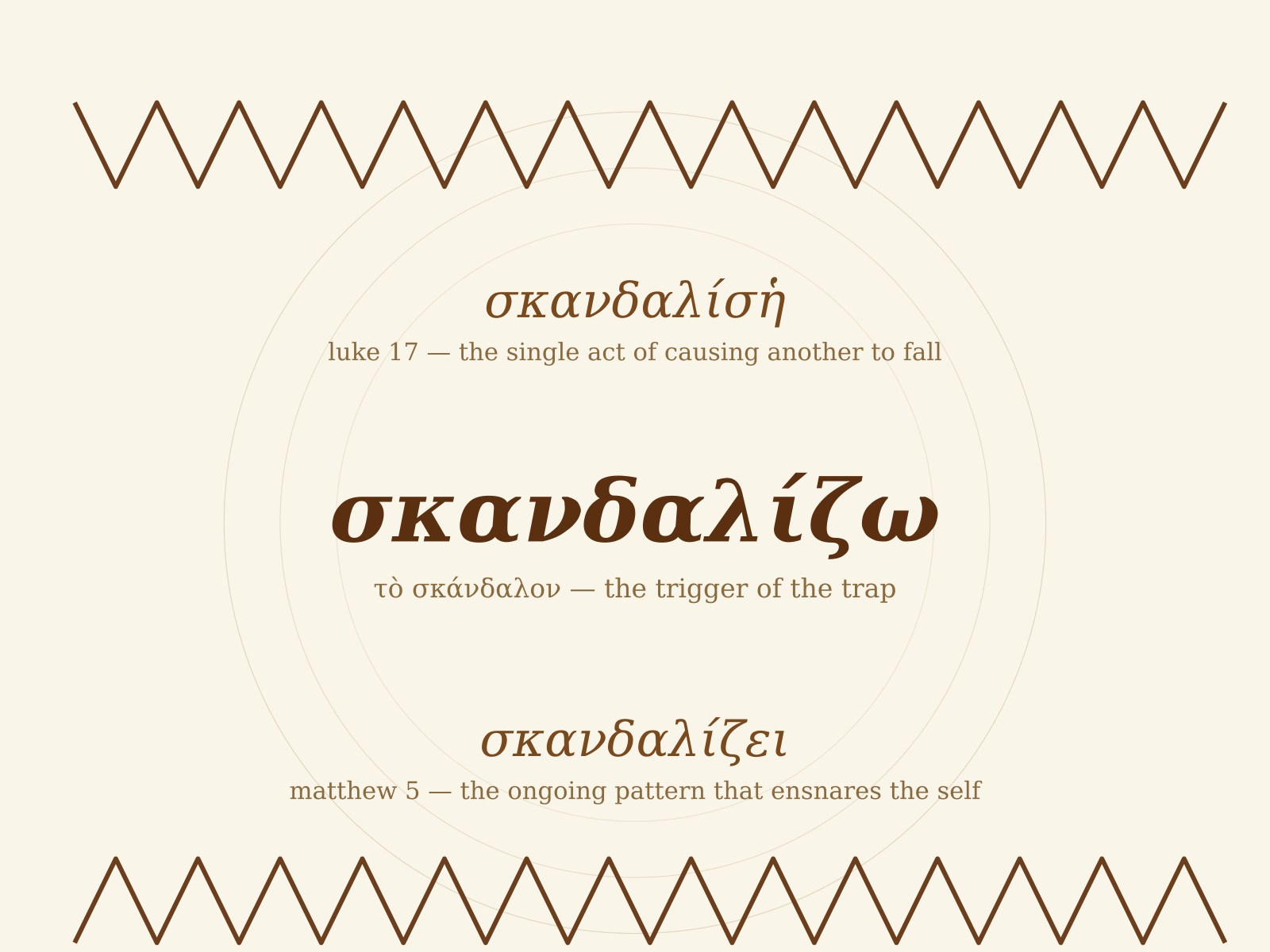
The Greek verb is σκανδαλίζω (skandalizō). It is the word from which we get the English word scandal, but its biblical meaning is much richer. It originally referred to the trigger of a trap, the mechanism that causes an animal to be caught. From there it came to mean to cause someone to stumble, fall, be ensnared, or be led into sin or unbelief.
The same verb appears in two passages that we rarely think of together, but which Jesus himself connected.
First we’ll look at these separately, and then we’ll look at where Jesus combined them together.
In Luke 17, Jesus says:
Luke 17:1-2 (CSB) — “He said to his disciples, ‘Offenses will certainly come, but woe to the one through whom they come! It would be better for him if a millstone were hung around his neck and he were thrown into the sea than for him to cause one of these little ones to stumble.'”
The Greek verb is σκανδαλίσῃ (skandalisē). This is an aorist active subjunctive. The focus is on the act itself: causing another person to stumble, to fall into sin, or to be spiritually ensnared.
Now compare that to Jesus’ words in Matthew 5:
Matthew 5:27-30 (CSB) — “You have heard that it was said, Do not commit adultery. But I tell you, everyone who looks at a woman lustfully has already committed adultery with her in his heart. If your right eye causes you to sin, gouge it out and throw it away… And if your right hand causes you to sin, cut it off and throw it away…”
Here Matthew uses σκανδαλίζει (skandalizei). This time the verb is in the present active indicative form. Rather than emphasizing a single act, it describes something that continually functions as a stumbling block. Jesus is speaking of whatever repeatedly becomes the trigger of the trap.
That grammatical difference is significant.
In Luke, Jesus warns against becoming the stumbling block for someone else. In Matthew, Jesus warns us not to tolerate the stumbling block in our own lives. In other words, Luke says: Do not become the stumbling block. Matthew says: Do not tolerate the stumbling block.
The eye in Matthew is obviously not literally sinful, nor is the hand morally evil. Jesus is simply using vivid hyperbole to teach that anything which continually ensnares us into sin must be dealt with on a radical basis.
Luke takes that exact same concept and turns it outward. A person can become the trigger of the trap for someone else.
This means these passages interpret one another.
Matthew teaches personal holiness. Remove whatever ensnares you.
Luke teaches love for others. Never become the thing that ensnares them.
Together they present a complete picture of Christian discipleship. We are called to wage war against every stumbling block in our own lives while taking extraordinary care not to become a stumbling block in the lives of others.
For this reason, Jesus Himself brings these teachings together into one discourse.
Matthew 18:6-9 (CSB) — “But whoever causes one of these little ones who believe in me to fall away, it would be better for him if a heavy millstone were hung around his neck and he were drowned in the depths of the sea. Woe to the world because of offenses. For offenses will inevitably come, but woe to that person by whom the offense comes. If your hand or your foot causes you to fall away, cut it off and throw it away… And if your eye causes you to fall away, gouge it out and throw it away…”
Notice what Jesus does? He begins with the warning about causing others to stumble. Then, without changing subjects, He immediately turns to the eye, the hand, and the foot that cause us to stumble. This connection isn’t something being imposed on the text; Jesus Himself makes it!
This also explains why He speaks so severely in both passages.
In Matthew, the consequence of refusing to remove a stumbling block is eternal judgment.
In Luke, the consequence of becoming a stumbling block for another is so dreadful that Jesus says it would be better to have a millstone hung around one’s neck and be thrown into the sea.
Why such strong language?
Because sin is never merely private.
The stumbling block that destroys me today may become the stumbling block that destroys someone else tomorrow. Likewise, my carelessness, compromise, or example may become the very trap by which another believer falls.
So Jesus gives His disciples two inseparable commands.
Remove every stumbling block from your own life.
Never become a stumbling block in the life of another.
The same verb, σκανδαλίζω, binds these teachings together. One passage looks inward. The other looks outward. One addresses the causes of our own sin. The other addresses our influence on the life of others. Together they reveal that holiness and love cannot be separated.
This has profound implications for the modern Church.
Today I stopped at QuikTrip to grab a drink. As I walked to the counter, one attractive young woman approached from one direction wearing clothing so revealing that it was deliberately sexually provocative. I won’t describe her, but no one would disagree with this framing if they saw her. I turned away, only to find another attractive young woman approaching from the opposite direction dressed in much the same way. The sad irony was that both women were wearing crosses.
I’m going to be very open, raw, and honest here: these women presented their bodies as very powerful temptations.
I want to make a simple point here: I’m not a teenager or a young man in the vigor of his youth, where people often assume sexual temptation is most intense. If a teenage boy is tempted, people often say, “Well, he’s young.” If an immature Christian man is tempted, people say, “He needs to grow.” But we often mistakenly assume that older men simply “have it under control”, which is why so many of them internalize this fight and become silent about their struggles.
I’m a spiritually mature man, but this temptation was powerful and this trap was very dangerous. So I took responsibility for my own heart because that’s exactly what Jesus commands me to do. And, because of my experience, I also know that the real fight for me will come tonight, where the seeds of temptation that were sown in my heart today will attempt to come to life. So my battle will be real. And I know, if my eye causes me to stumble, I am responsible before God for my own response.
But why does the conversation always end there?
Where are the voices asking whether Christians should also take responsibility for becoming stumbling blocks? After all, what I experienced today is far from a singular event. For most men who are spiritually alive enough to still be fighting this battle, it could be a daily occurrence. From browsing the internet to going literally anywhere outside during the summer time.
For decades the Church has rightly preached Jesus’ words from Matthew to men and the concept of lust in general. We have correctly told men to discipline their eyes, guard their hearts, and crucify their lust. And we must continue preaching exactly that!
But why have we become almost completely silent about the obvious connection of this to Jesus’ words from Luke?
If it is sinful for a man to cultivate lust in his own heart, is it not also sinful to knowingly cultivate lust in someone else’s heart? If Jesus condemns the one who lusts, does he not also pronounce woe upon the one through whom the temptation comes?
These are not my words.
They are his.
Before someone objects, let me be clear: a woman is not responsible for every lustful thought a man has. Sin comes from the human heart. Men will answer before God for their lust, regardless of what anyone else is wearing. And this is why there is not shifting of blame possible here.
But that is only half of what Jesus teaches.
The person who knowingly becomes a stumbling block also bears moral responsibility.
Our culture has taught women to seek validation through sexual attention. Tragically, much of the Church has simply baptized that message. Clothing that intentionally accentuates female sexuality in order to provoke desire is celebrated as confidence, empowerment, or self-expression. And Christians often defend it with the same arguments the world uses. But Jesus does not.
So, fathers, teach your sons to flee lust. But also teach your daughters that their beauty is a gift to be stewarded for their future husbands in holiness, not a tool for drawing sexual attention.
Young men, look for wives who desire holiness more than admiration.
Young women, seek to be known for purity before attractiveness. Ask not only, “Am I free to wear this?” but also, “Could this become a stumbling block to my brother for whom Christ died?“
Pastors, preach Matthew 5 with courage. But preach Luke 17 with equal courage.
Churches, disciple both men and women with equal seriousness.
We have spent generations telling men, “Do not lust.”
Jesus said that.
But He also said, “Do not become the reason another person stumbles.”
We have created a Christianity that condemns the man who lusts while often applauding the woman who deliberately cultivates lust. Jesus condemns both. The same Savior spoke both warnings. The same Greek verb binds them together. The same Lord who commands us to remove every stumbling block from our own lives also pronounces woe upon those who become stumbling blocks in the lives of others. We cannot faithfully preach one without preaching the other.

