Our Journey
My wife and I were called into the mission field in 2010 and spent the next decade working in the underground Church, which fundamentally reshaped our understanding of God’s Kingdom, the mission of the Church, and the nature of Christian community.
Then we returned to the United States in 2020 during the pandemic and entered full-time ministry, where we had to confront the reality or how our understanding of the Church had changed. This wasn’t a clean or tidy journey. Over time we came to realize that God had not brought us back simply to leave behind what we had learned abroad, but rather, to participate in his work of renewal and refreshing within his Church in this place.
The underground church caused us to think about people, relationships, discipleship, prayer, and spiritual gifts when we think about the Church. We think about how believers can be connected to one another in meaningful ways. We think about how each person’s gifts can help meet another person’s needs. We think about seeking the Lord together and depending upon him to provide what is necessary for the work he has given us.
The institutional church, however, operates from a different frame of reference. The organizational demands of the institutional church fundamentally shapes her priorities: budgets, facilities, staffing structures, programs, committees, branding, demographic analysis, and administrative systems. These concerns are not inherently wrong, nor do they necessarily reflect unfaithfulness, but, they are when they supersede the core interests of Christ for his Church.
Facing Trials
My years in formal ministry also exposed me to the darker realities of ministry that can emerge wherever power and institutions intersect. We saw financial influence distort accountability, organizational concerns overshadow spiritual concerns, and fear of conflict eliminate faithful correction. Money, influence, and control are the key attributes around which the decisions of the institutional Church often turn. And the offense of God’s word was viewed as a threat to be mitigated at all cost.
This time was characterized by trials. I provoked the wrath of wealthy members when I tried to reform the budget and establish financial transparency in the use of church funds. I offended elders when I preached against divorce. I received phone calls from even out of State churches asking for clarification on gossip about me that reached their members.
So, after facing the choice to censor God’s word and keep my well-paying ministry position, we made the difficult decision to preach the Word and transition out of formal ministry to return home to Kansas City. I was exhausted. I was wounded. And I wanted very little to do with formal ministry.
Yet despite everything, we still loved the Church.
We believe there is one, holy, universal, and apostolic Church: God’s people gathered from every nation and generation through the saving work of Jesus Christ. It was through the Church we first heard the good news. It was through her we learned the Scriptures and began to follow Jesus. It was through her we received encouragement, correction, friendship, and care. And it was through her ministry we witnessed faithful examples of love, generosity, repentance, and perseverance. Some of the most Christlike people we have ever known were found within the Church.
So, we could not give up on the Church and spent the next several years searching for a church home.
Learning from the Pew
This season became one of the most important parts of our journey.
For most of my adult life I had served in some form of church leadership. For the first time in many years, I was able to experience church simply as a member of the congregation. We entered churches not as leaders, teachers, or ministry staff — in fact I refused such requests — but simply as believers seeking Christ, fellowship, and Christian community.
The experience was eye-opening.
We began to notice how leadership culture shapes church culture. Leaders who become consumed with building programs often form disciples who struggle to build meaningful relationships. Leaders who rarely seek the Lord together in prayer often produce disciples who rarely seek the Lord in their daily lives. Leadership structures that lack transparency and accountability often produce communities marked by distrust and disengagement.
These observations may seem obvious, but they showed me the true impact of a church’s real priorities on the life church’s life.
At the same time, we discovered something equally important.
We found many sincere Christians who loved the Lord deeply. We met believers who faithfully served their churches with humble and sacrificial hearts. We encountered people who hungered for Scripture, desired genuine discipleship, and sincerely wanted to obey Christ. We also met many who were discouraged, disconnected, and quietly longing for something deeper.
Seeing these realities together forced me to examine my own life. Rather than asking what was wrong with the Church, I began asking whether I was faithfully using the gifts God had given me for the good of his people. God had equipped me to preach and teach the word, but I wasn’t using those gifts anymore.
During those years, God was healing wounds I did not know how to heal. He was restoring my love for his people. He was rekindling my desire to preach and teach his word. Most importantly, he was showing me that the problems I had witnessed were not given to me so that I could become bitter or cynical, but so that I could participate in his work of renewal.
What We Observed
As we visited different churches, we saw a certain pattern beginning to emerge.
I think it’s important to say that we do not believe these patterns describe every institutional church, nor do we believe faithful Christians are absent from established congregations. In fact, our years of searching convinced us of the opposite. We met many believers whose love for Christ encouraged us deeply. Nevertheless, the pattern we saw repeating itself was that the organizational demands of established churches were distorting their priorities.
Churches today must often devote tremendous energy to maintaining budgets, facilities, staffing structures, programs, branding, administrative demands, and organizational systems. While these responsibilities frequently arise from sincere efforts to steward resources well, they can gradually consume so much attention that prayer, discipleship, and spiritual formation become secondary concerns.
What became clear to us was that when the Church’s internal life weakens, other identities rush in to fill the vacuum. Political loyalties, cultural tribes, and ideological commitments can begin shaping Christian identity more powerfully than the teachings of Jesus himself, resulting in confusion, division, and a diminished Christian witness.
Yet our deepest concern was theological: the gospel itself comes under pressure whenever institutional interests, cultural pressures, or political commitments become primary. The message of God’s Kingdom is diluted to accommodate the Church’s worldly interests and alliances. This compromise causes grace to become detached from repentance, forgiveness to be emphasized while transformation is neglected, the call to follow Jesus to become indistinguishable from political rallying calls, and holiness — “without which, no one will see the Lord” — to become a cultural vulnerability. The result of all this compromise is that the Church loses her ability to make real disciples.
These observations convinced us that renewal is needed.
Scripture repeatedly shows God calling his people to repentance whenever they drift toward spiritual apathy, compromise, or worldliness. And all throughout history, renewal has often begun with small groups of ordinary believers who humbled themselves before God and sought him wholeheartedly.
We believe the same remains true today.
A Renewed Calling
We discovered that the Lord had been moving this whole time to not only heal our wounds, but also rekindle our love for his people and renew our desire to teach, disciple, and serve. We became convinced that it is not enough to merely identify problems. But meaningful faithfulness requires participation in God’s work of renewal.
Some believers participate in that work by strengthening healthy churches from within. Others labor to reform erring churches. Still others are called to begin new works.
We believe this is where the Lord has led our family.
Since no door opened for us to integrate into an existing community and serve from within that context, we became convinced that we should draw upon our years of experience in home church ministry and begin something new in our city.
So we are beginning a home church, not as a departure from the Church, but as participation in her renewal.
Why a Home Church?
Our decision to begin a home church does not arise from the belief that homes are inherently holier than church buildings, nor from the belief that home churches alone represent authentic Christianity. That sentiment is all-too prevalent in American house churches. And it does real harm.
Instead, we were privileged to experience firsthand the unique strengths of the home church, and we want to cultivate those strengths here in Kansas City.
We know what it feels like to start a home church. We understand the uncertainty, hesitation, and doubt. We have experienced the isolation. We have heard the condescending remarks about going to “real church.” But we have also experienced its blessings. We have experienced authentic fellowship. We have seen believers use their spiritual gifts to selflessly serve one another. We have participated in communities where people truly know one another, carry one another’s burdens, pray for one another, and walk together in faithful discipleship. We have experienced worship that is deeply participatory. We have seen believers grow through mutual encouragement, shared responsibility, and meaningful accountability. And we have experienced the kind of Christian community that doesn’t turn around money, influence, or power.
For us, the home church is not an end in itself. It is simply the context in which we believe the Lord has called us to pursue discipleship, fellowship, worship, hospitality, and mission.
An Invitation
We do not claim to have all the answers.
We are simply seeking to be faithful to what the Lord has placed before us.
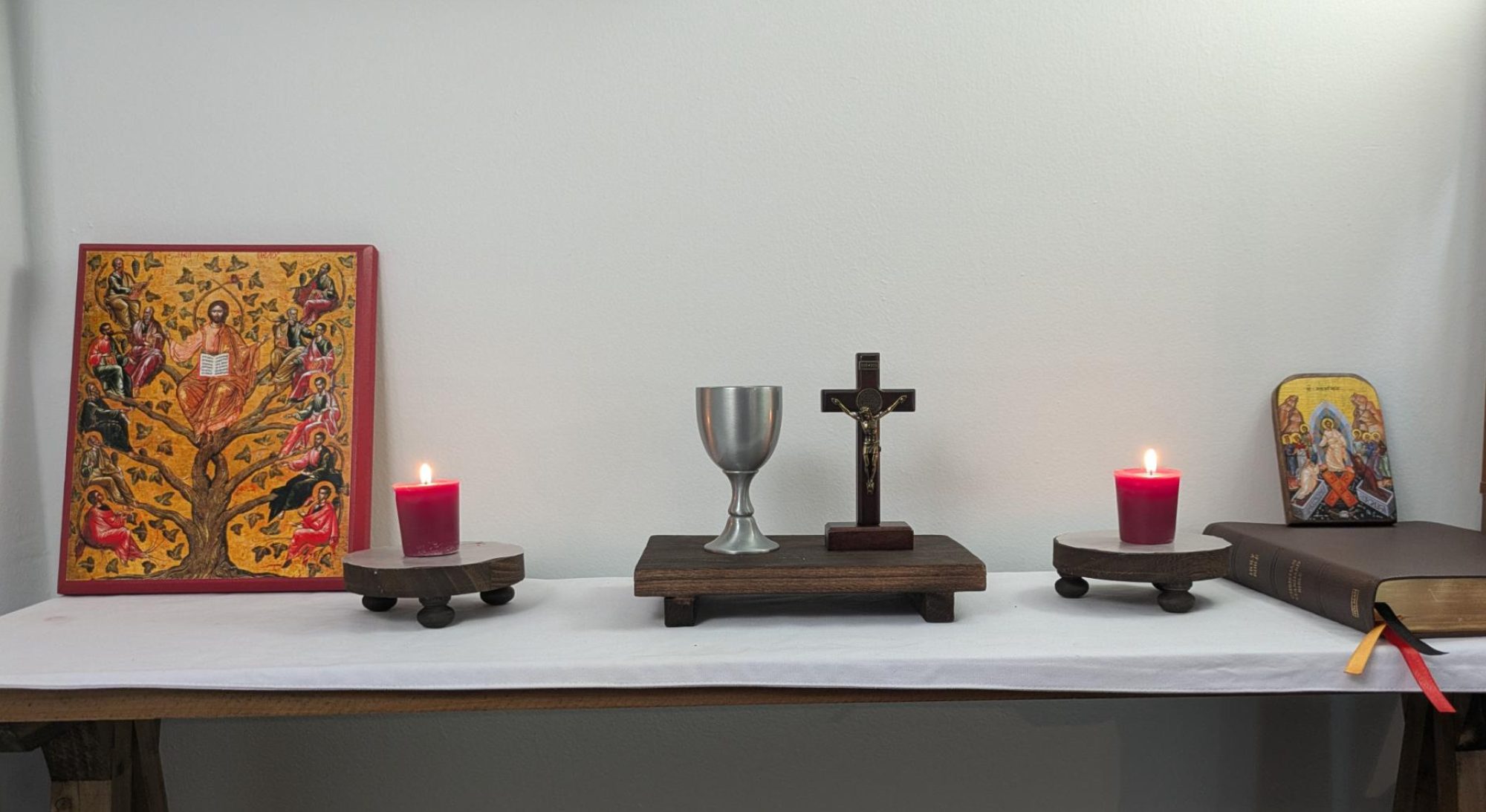
Our desire is to gather a community devoted to prayer, Scripture, the Lord’s Supper, discipleship, hospitality, and the life of the Spirit. We desire to grow together in obedience to Jesus Christ and to participate, in our own small way, in the renewal of his Church.
May the Lord be pleased to use this small effort for the glory of Christ, the good of his people, and the advance of his Kingdom.

